Sourcing a reliable USB car charger OEM supplier from China is a critical step for automotive accessory brands, retailers, and B2B distributors. The market is saturated with traders and factories, creating a noisy landscape where distinguishing a capable manufacturer from a middleman is difficult. The core challenge is not just finding a low price; it is finding a partner who understands the specific electrical engineering constraints of automotive environments, such as voltage fluctuations, heat dissipation, and safety certifications.
Many buyers face two primary pain points: receiving products that fail under high load (voltage drop under 10A+ current) and encountering compliance issues where products lack valid CE or FCC approvals for their target markets. This article cuts through the noise by outlining how to evaluate suppliers based on verifiable technical capabilities, standard trade terms, and realistic expectations regarding Minimum Order Quantities (MOQ), pricing structures, and lead times. By focusing on suppliers with a documented track record in automotive electronics, you can mitigate risk and secure a stable supply chain for your USB car charger OEM project.
The most common mistake in sourcing USB car chargers is comparing only the input voltage (DC 12V) and output power (e.g., 45W). This is insufficient. A high-quality OEM supplier demonstrates expertise through intelligent power management and robust physical design.
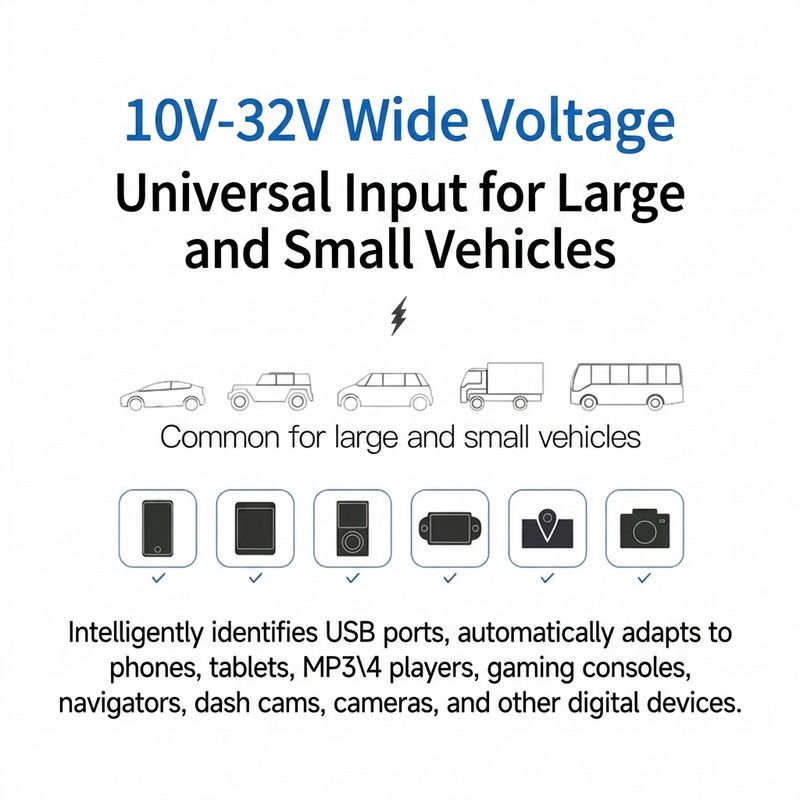
A credible supplier will offer chargers with Intelligent ID Recognition and comprehensive multi-layer protection. They should support input ranges of DC 12V–24V to ensure compatibility with cars, SUVs, trucks, and buses, not just passenger vehicles.
Automotive battery systems are complex. While most cars run on 12V systems, trucks and commercial vehicles operate on 24V systems. A professional OEM supplier will design circuits that accept this universal range without damaging the internal components. Furthermore, modern smartphones and tablets require specific handshake protocols to accept fast charging. A generic charger may output the correct wattage but fail to trigger the fast-charge mode on specific brands like Huawei, Xiaomi, or OPPO due to lack of ID recognition.
According to technical data from established automotive electronics manufacturers, high-end OEM units now include features such as:
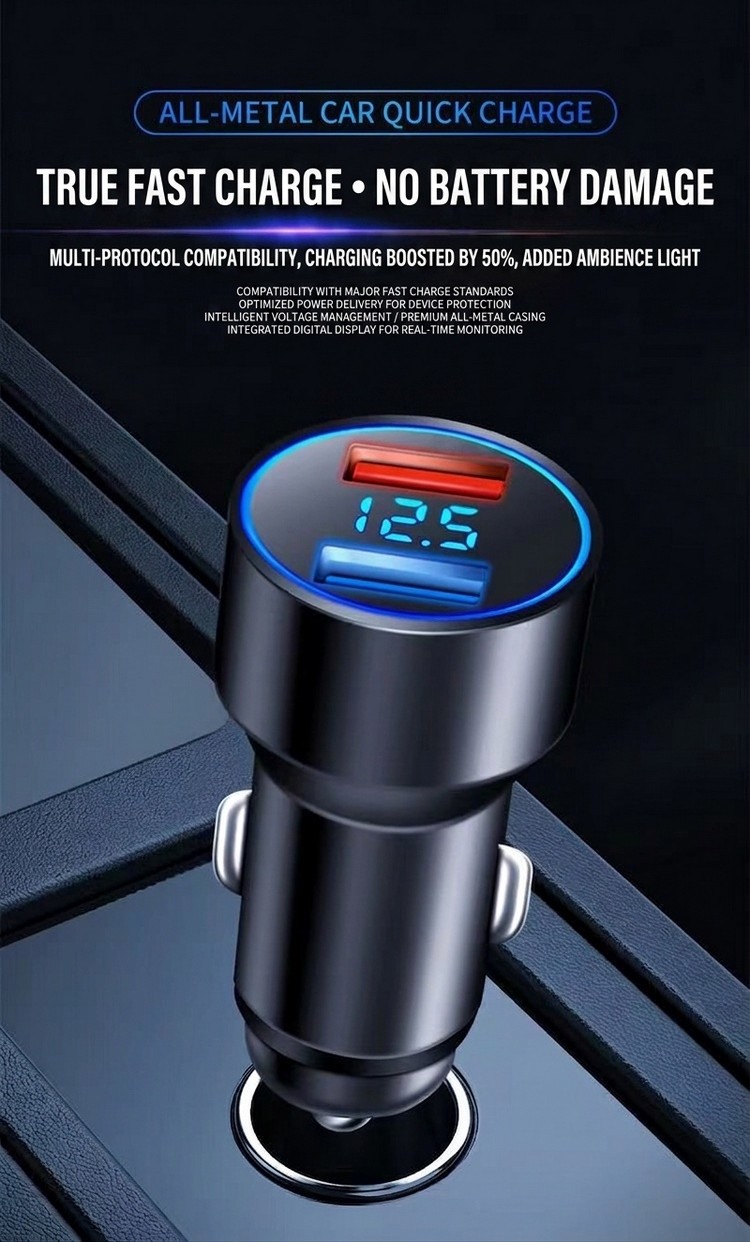
When reviewing a supplier’s product line, ask for the schematic of their protection circuit. If a supplier only offers basic plastic shells without explaining the internal MOSFETs or protection ICs, view this as a red flag. Look for suppliers who explicitly state that their units are "intelligent" and can handle "high-power" loads. For example, a supplier might advertise a dual-port charger where each port can deliver between 4.5V–12V at up to 10A. This flexibility indicates a sophisticated power architecture suitable for OEM clients who need consistent performance across various vehicle types.
Negotiating trade terms requires understanding the economics of OEM manufacturing. The "one size fits all" pricing model does not exist. Costs and lead times are directly correlated with customization levels and component sourcing.
Standard OEM orders for branded USB car chargers typically require an MOQ ranging from 500 to 1,000 units for stock models with logo printing, and 2,000 to 5,000 units for fully custom designs (new mold, custom PCBA). Lead times range from 7-15 days for stock and 30-45 days for custom OEM production.
MOQ Dynamics:
Pricing Factors: The price per unit drops significantly as volume increases. A supplier will price a 1,000-unit order at a premium to cover overheads. A 10,000-unit order will benefit from bulk component procurement (PCB, connectors, capacitors) and efficient assembly line scheduling. Additionally, suppliers with established trade channels in markets like Malaysia, Singapore, the UAE, and Europe often have standardized pricing tiers that reflect the specific compliance costs for those regions.
Lead Time Breakdown:
Always request a "Production Schedule" document from your supplier. It should clearly break down when materials are procured, when PCBA assembly begins, and when final QC occurs. If a supplier quotes a 7-day lead time for a custom OEM order involving new packaging and testing, treat this estimate with skepticism. Realistic timelines account for buffer periods for quality control failures.
Trust is built on verifiable facts, not marketing adjectives. To establish authority in your own supply chain, you must audit the supplier’s credentials.
Verify the supplier’s legal entity, certification validity, and production capabilities through a structured audit. Prioritize manufacturers with a clear "About Us" section that details their automotive electronics specialization, rather than generic electronics traders.
A reputable supplier, such as Shanghai Rusi Technology, which positions itself as a China OEM/ODM dash cam and car electronics manufacturer, will provide transparent information. Their public product knowledge bases often detail specific models, input/output voltages, and certification types (CE, FCC). For instance, a trusted supplier will list the specific protective features of a product, such as "magnesium alloy valves" in tire pressure systems or "LED digital battery level" displays in chargers. This level of detail indicates that the supplier controls the design and production, not just re-sells goods.
Key Verification Steps:
During the initial negotiation, request a "White Paper" or technical datasheet for the charger. If the document is generic and lacks specific component names (e.g., specific MOSFET models, connector types), the supplier is likely trading, not manufacturing. A true OEM partner will share detailed specs, including the thermal management strategy (e.g., heat sink materials used) and the lifespan rating of the connectors.
The following table summarizes the differences between ordering stock items and full custom OEM runs, helping you choose the right path for your business goals.
| Feature | Stock Model (Logo Only) | Full Custom OEM (New Design/PCBA) |
|---|---|---|
| MOQ | 100 - 500 units | 2,000 - 5,000+ units |
| Lead Time | 5 - 10 days | 30 - 45 days |
| Cost Per Unit | Higher (small batch) | Lower (economies of scale) |
| Customization | Color, Logo, Packaging | Physical Shape, Internal Circuit, Ports |
| Risk | Low (proven design) | Moderate (needs thorough QC) |
| Certification | Uses existing factory certs | Requires new testing for specific market |
| Ideal For | Testing market demand, small retail | Brand differentiation, large scale distribution |
Note: For suppliers with advanced digital display features (like the CG21 model with dual fast-charge ports), even "stock" orders may have higher MOQs than basic chargers due to the complexity of the LCD/LED component sourcing.
Most professional OEM suppliers design chargers with a DC 12V–24V input range. This ensures the device is safe for use in standard passenger cars (12V systems) as well as trucks, SUVs, and buses (24V systems). Always verify that the spec sheet explicitly states "12V/24V universal" to avoid compatibility issues in mixed fleets.
They are critical for legal sales in Europe and North America, respectively. CE certification ensures the device meets health, safety, and environmental protection standards for the EEA. FCC certification guarantees that the electronic emissions do not interfere with other devices. Sourcing a supplier who cannot provide valid, model-specific test reports for these certifications exposes your brand to significant legal and financial risk.
Yes. Many OEM suppliers now offer Intelligent ID recognition that can be tuned for specific brands (e.g., Huawei SuperCharge, Apple PD, Xiaomi QC). When discussing your OEM project, specify which protocols you need to support. A supplier with high-power capability (up to 10A per port) will typically offer the most flexible protocol configuration options.
Sourcing a USB car charger OEM supplier from China is a process of risk management and technical alignment. The most successful partnerships are formed with manufacturers who specialize in automotive electronics and can demonstrate deep technical knowledge, from 12V/24V universal compatibility to intelligent ID recognition and robust safety protections.
To proceed effectively:
By focusing on suppliers with a documented track record in automotive hardware and adhering to these verification steps, you can secure a reliable supply chain that supports your brand’s reputation for quality and safety.